
Full Automation at Any Cost? Why “Hybrid” Is Often the More Economical Choice

In coolant management, there are three paths to automation: partial, full, or hybrid automation. All have their justification, but in the end, economic efficiency is what matters.

For small and medium-sized enterprises in particular, we at GIMAT have defined a smart middle ground with the DOSIMETRIX (registered as a utility model with the German Patent and Trademark Office, DPMA): hybrid automation.

What does it entail?

  1. Automatic core: Mixing and dosing are 100% automatic (eMix1500). This guarantees maximum precision and stabilizes the process on a long-term basis.
  2. Real-time transparency: The fill level is continuously monitored “live” and without contact. The system operates completely maintenance-free in this regard.
  3. Human-in-the-loop: The human operator remains the crucial corrective element. Why? Because any inline sensor technology—no matter how precise—requires regular attention when dealing with demanding media (such as esters or glycol) or the “natural” pH drift. We do not promise a “one-size-fits-all, all-inclusive carefree package” that ignores physical necessities. Targeted digital manual measurement is often more reliable here than highly complex sensor technology that still requires manual cleaning and calibration.
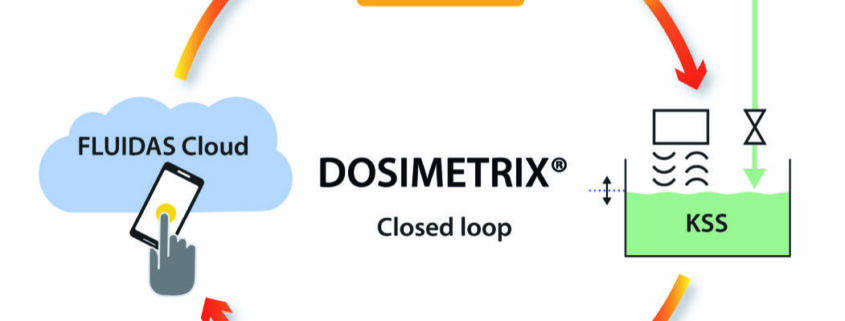
  4. Closed-loop digitalization: All data flows into the FLUIDAS cloud. The system automatically reports requirements, controls the replenishment process itself, and documents everything in a legally compliant manner. This creates a closed control and information loop (see graphic).One detail that makes our ‘closed loop’ particularly efficient: If you use ATAGO refractometers, you can transfer the measured values directly to the app and the FLUIDAS cloud using the integrated NFC function. No manual logging, no transmission errors. For all other measured variables, the system remains flexible and allows manual entry—ensuring the data foundation for the eMix1500 is always complete.

Conclusion:

If an expert has to be on-site anyway for the maintenance of the measuring systems, our hybrid approach is often the smarter path: It massively relieves personnel of mixing and dosing tasks, while leveraging human expertise for the final checks.

This saves high investment costs and creates genuine transparency—without raising false expectations of maintenance-free full automation.

How do you handle this in practice? Do you consistently rely on “full auto,” or is the human factor still the most important supervisory authority in your operations?

Did you know that the Water Resources Act affects your cooling lubricant system?

Many companies use cooling lubricant emulsions (KSS) – but not all of them know that these substances must be classified according to water hazard classes (WGK) and that handling them is subject to strict requirements under German water legislation.

The general requirements of the Water Resources Act (WHG) are specified in the AwSV (Ordinance on Installations for Handling Substances Hazardous to Water).
Even individual tanks with a volume of less than 220 l can be AwSV-relevant – but the actual topic only really becomes relevant with automation.

Automation is not a risk – if it is done right:

Manual filling processes are usually observed directly – employees recognize overfilling immediately.

Automated systems, on the other hand, run unattended – and this is precisely why the AwSV requires technical safeguards such as overfill protection, leakage detection and retention devices for such systems.

This is no reason to worry – but a reason to rely on well thought-out systems.

The good news:

There are solutions that not only fulfill these requirements, but also implement them in a practical and reliable manner – first and foremost Brisco Systems GmbH:
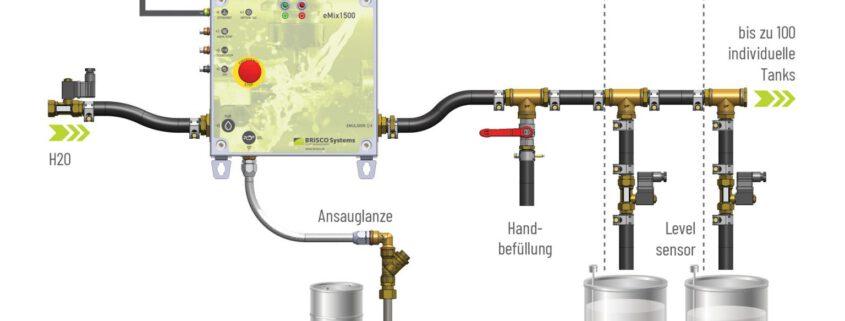
With the eMix1500 in combination with the eLevel100, a system is available that:

  • via a fixed cable connection,
  • an integrated level sensor,
  • and an automatic emergency stop system

and thus technically rules out overfilling.

Are you planning to fill your cooling lubricant tanks automatically?

We have been dealing with the requirements of the Water Resources Act and the AwSV for many years. As a system integrator and official sales partner of Brisco Systems in Germany, GIMAT Liquid Monitoring advises companies on the planning and design of AwSV-compliant systems.

Feel free to contact us – you are in the best hands with us.

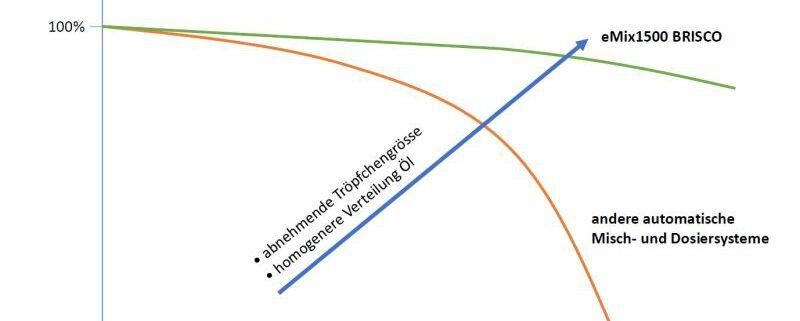
With cooling lubricants, droplet size determines the emulsion quality

Small droplets and homogeneous oil distribution are crucial for the service life of your cooling lubricant emulsions – and therefore your operating costs. We have intensively studied the available systems for the automatic mixing and dosing of cooling lubricant emulsions. We compared various providers and technologies – with a clear result:

The eMix1500 from the Swiss company Brisco Systems GmbH convinced us the most in terms of mixing quality, droplet size distribution, ease of use and integration capability. That is why we have included the eMix1500 in our sales program and are now offering it as a central component of our (hybrid) automation solutions in cooling lubricant fluid management.

The eMix1500 works with SmartFusion technology. This ensures a precise mixing ratio, pressure and turbulence. This creates micro-droplets that are optimally distributed in the medium and enable a significantly longer service life. The result: lower concentrate consumption and more stable processes.

Micro-droplets. Mega effect: eMix1500 revolutionizes your coolant fluid management. Interested? Please contact us.

Cooling lubricants: Automatically achieve the perfect coolant emulsion with smartFusion technology

Mixing water and oil to create a stable cooling lubricant emulsion is a critical step in metalworking. Many companies have been using Venturi or proportional mixers for years – but the concentration has to be set manually.

However, modern fluid management demands more:

  • Automatic setting of the target concentrations
  • Optimal droplet size
  • Homogeneous oil distribution
  • Real-time control and system integration

However, conventional technology cannot be used in mixing devices with automatically regulated cooling lubricant concentration. Brisco Systems, the Swiss developer and manufacturer of smartFusion technology and the eMix1500, has consistently implemented the high requirements for automatic mixing and is thus setting new standards:

  • Almost perfect emulsion formation with very high dispersion quality
  • Long-term stability without segregation
  • Precise concentration control in real time
  • Integration in hybrid or fully automated
  • Fluid management solutions

The perfect emulsion is now created automatically.
The eMix1500 is the new reference for intelligent coolant mixing.

GIMAT is an official sales partner of Brisco Systems in Germany and brings this technology directly into your production.

Hybrid automation for cooling lubricants – the new way

We believe that we need to rethink coolant fluid management. We often come across the terms “manual” and “fully automatic” when it comes to measuring, dosing, mixing and documenting cooling lubricants.

What if there was a third way?

A path that not only integrates technology, but also consciously focuses on people in certain areas, with their actions, their experience and their flexibility. A path that will allow digital intelligence in the future without expensive full automation?

We call this approach hybrid automation.

It’s more than a system – it’s a way of thinking. A new way for humans, machines and data to work together. We are convinced that anyone who thinks hybrid automation is thinking about the future.

  • A specialist article will be published shortly.
  • A white paper will follow.

We look forward to exchanges, perspectives and co-creators.

Smart Buildings – Are you already using sensors, LoRa, dashboards or AI to monitor water and wastewater systems in buildings?

The demands placed on modern buildings are increasing—not only in terms of energy efficiency, but also in the monitoring of water and wastewater systems.

Technologies such as LoRaWAN, dashboards, and AI-powered analytics now enable precise, automated, and sustainable monitoring—even in existing buildings.

Here at GIMAT Liquid Monitoring, we explore how far these technologies have already advanced in practical application—and where untapped potential still lies.

Cooling Lubricant Fluid Management: Initial Steps Toward Automation for Individual Tanks

Here’s how it works:

  1. Manual measurements of oil concentration using ATAGO digital refractometers.
  2. Manual entry of the respective oil concentrations into the eMix1500 from Brisco Systems GmbH, one of the most advanced automatic mixing and dosing systems for cooling lubricant emulsions.
  3. Contactless level sensors from GIMAT Liquid Monitoring.

This keeps the levels in the individual tanks at the machine tools (almost) constant. And the concentration is always at the optimal level.

As an authorized distributor for ATAGO (Japan) and Brisco (Switzerland), you get everything from GIMAT as a single source!

Digital Fluid Management Explained in 3:18 Minutes – How Simple Cooling Lubricant Monitoring Can Be!

Monitoring and maintaining cooling lubricants (CL) is a core component of modern manufacturing processes. Our partner SDNORD has released a new explanatory video showing how the FLUIDAS software helps companies in the metalworking industry manage their CL processes digitally, securely, and efficiently.

A special highlight: Using the ATAGO refractometers and measurement devices for pH and conductivity, among others, distributed by GIMAT, measured values can be transferred directly and paperlessly into FLUIDAS. This saves time, reduces sources of error, and lowers costs – a real added value for any modern fluid management system.

And the best part: FLUIDAS is easy to set up, intuitive to use, and cost-effective – without any complicated IT projects or lengthy training. This makes getting started with digital CL monitoring completely straightforward.

GIMAT Liquid Monitoring is a sales partner for FLUIDAS.

Watch now and discover how FLUIDAS takes your fluid management to the next level!

FLUIDAS® Explainer Video »

Take a look now and feel free to contact us if you’re interested – there are currently attractive entry opportunities available.

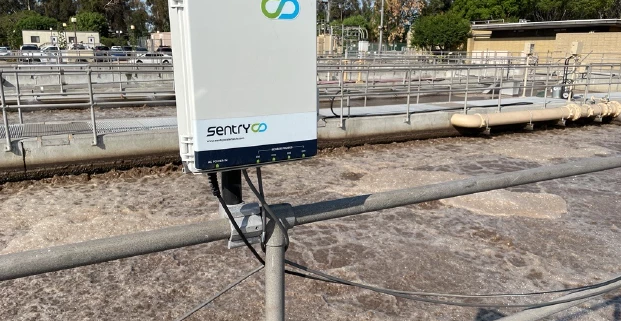
SENTRY Real-Time Monitoring Protects Your Wastewater Treatment Plant from Disruptions Caused by Heavy Rain

Rain can significantly disrupt the activated sludge process in a treatment plant. Case studies show that even 10 mm of precipitation can temporarily impact the BOD value in the influent—with effects measurable at the effluent for over 24 hours. This demonstrates how critical even seemingly minor changes in the inflow can be.

Overview of Process Engineering Impacts:

  • Dilution: Rainwater reduces the concentration of organic substances needed by microorganisms in the activated sludge process.
  • Sludge Washout: Activated sludge can be washed out of the biological treatment stage.
  • Reduced Contact Time: A decreased hydraulic retention time limits the period available for the degradation of organic matter.
  • Nutrient Deficiency: Diluted wastewater leads to fewer available nutrients, which restricts microbial activity.

This is where the advantages of SENTRY probes come into play: With SENTRY sensors, such effects can be detected in real time. You receive timely data that enables optimal control of your plant—even under rapidly changing influent conditions.

Learn from us how modern sensor technology can sustainably improve your operations!

GIMAT delivers more than just wastewater measurement technology. We also make it operational.

We at GIMAT recently successfully completed a demanding project at a food production facility in northern Germany: the existing wastewater measurement infrastructure was comprehensively upgraded – including control cabinet wiring and the integration of new sensors, such as a SIEMENS flow meter.

A particularly challenging aspect was the installation of part of the equipment in a manhole beneath a public road. We handled this too – from setting up the construction site and implementing safety measures, to the professional commissioning.

A highlight: The outdated paper-based recording system was replaced by a cloud-based data solution. Previously, the customer had to leave the facility to read the values directly from a paper roll at the measurement point.

Today, measurement data is transmitted directly to the cloud via LoRaWAN, provided by our partner LineMetrics – digitally, location-independently, and in real-time. The result: The customer can now identify problems immediately, take targeted action, and directly leverage optimization potential in their operations.

This project demonstrates: GIMAT doesn’t just supply components – we deliver functional, future-proof solutions.

Are you interested in modern wastewater technology solutions? Then contact us now.