When the Brewery Sleeps, the Wastewater Plant Starves: How Two Smart Sensors Solve the “Weekend Dilemma”
Wastewater treatment plant operators can reduce operating costs and reliably meet discharge limits thanks to SENTRY bio-sensors.
A strict effluent limit, two large breweries “off duty,” and a biological system on hunger strike: when local industries shut down production over the weekend, many wastewater treatment plants are pushed into a critical imbalance. Using a current customer case, GIMAT Liquid Monitoring demonstrates how a biological two-sensor system reduces the consumption of costly auxiliary chemicals like ethanol, protects budgets, and safeguards receiving waters.
The Invisible Drama on Friday Evening
Wastewater treatment plants never sleep. But their most important engine—the billions of microorganisms in the activated sludge tank—operates in sync with local industry. During the week, everything runs smoothly at the affected plant: two large breweries discharge their production wastewater. For the bacteria, this is a feast. They consume the dissolved carbon and use that energy to biologically remove environmentally harmful phosphorus from the water (enhanced biological phosphorus removal, EBPR).
But right on schedule—weekends and public holidays—the shock follows: brewery production stops, and the corresponding wastewater inflow suddenly ceases. At the treatment plant, a biological famine sets in. Without their usual carbon source, the microbiology slows down or stops. Natural phosphorus removal collapses.
The consequences are severe: total phosphorus (P\_tot) levels at the plant effluent rise uncontrollably. Even rapidly intensified chemical precipitation using iron salts has often failed in the past to consistently meet strict regulatory discharge limits. The plant regularly found itself in a critical compliance situation.
Ethanol: The Expensive Lifeline
The process engineering solution for starving bacteria seems simple: supply an external carbon source—high-purity ethanol. It acts like a liquid energy booster and immediately brings the biological process back on track.
But ethanol has a downside: it is extremely expensive.
Until now, manual dosing has been a risky guessing game:
- Dose too late, and phosphorus levels spike into the critical range—risking permit violations and regulatory intervention.
- Dose too long (for example, if the breweries resume discharge earlier than expected), and the plant wastes thousands of euros on unnecessary chemical consumption.
Even fixed timer-based dosing fails completely in this situation. The plant urgently needed “eyes” to monitor the bacteria’s metabolic state in real time.
Der digitale Blick auf das Wohlbefinden der Bakterien
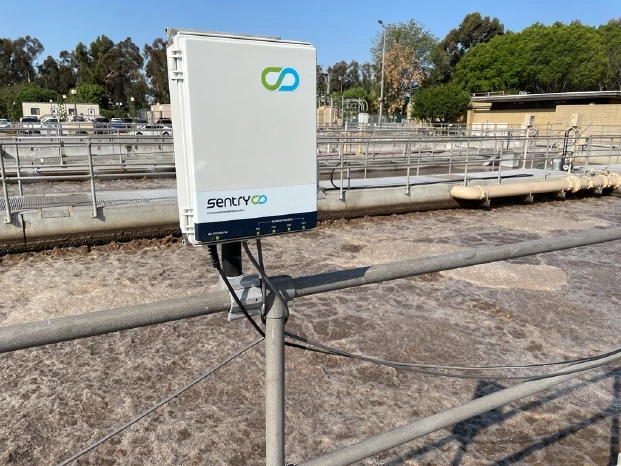
This is exactly where GIMAT’s solution comes in. Instead of dosing based on assumptions, the team installed a SENTRY dual-sensor system. The principle is innovative: a microscopically thin biofilm of the plant’s native microorganisms grows directly on the sensors. As these microbes metabolize available carbon, they generate tiny electrical currents. The system measures, minute by minute, the actual “heartbeat” and substrate availability of the biology.
To solve the weekend dilemma, the sensors are deployed as a strategic pair:
Sensor 1 in the influent (after primary clarification): acts as a digital sentinel, immediately detecting when the carbon-rich brewery load disappears over the weekend or returns on Monday.
Sensor 2 in the anaerobic zone (EBPR stage): directly measures the activity of phosphorus-accumulating organisms (PAOs). It reports in real time: “Warning—carbon limitation, phosphorus removal at risk,” or “Sufficient substrate—stop dosing.”
Precision Control: Full Throttle and Full Stop at the Right Moment
In practice, the result is a textbook example of modern, data-driven wastewater management. Ethanol dosing is no longer based on schedules, but on actual biological demand:
- Reliable compliance: when the SENTRY system detects carbon limitation, ethanol dosing starts automatically and precisely. Biological phosphorus removal continues without interruption, and effluent values remain safely below regulatory limits.
- Automatic cutoff: as soon as the breweries resume operation and natural carbon returns, the influent sensor responds instantly. The ethanol pump stops immediately—preventing any waste of expensive chemicals.
Conclusion: An Investment That Pays for Itself
This success story shows that sustainable water protection and cost-efficient plant operation are not mutually exclusive. With GIMAT’s SENTRY system, operators no longer react to past conditions but control the process proactively. Thanks to the substantial savings in ethanol consumption, the reagent-free and low-maintenance system pays for itself in a very short time—ensuring peace of mind in the control room, even over the weekend.