
• Deutsch Deutsch German de
    • English English English en
    +49 (0)881 628-10 | info@gimat.de
    GIMAT Liquid Monitoring
    • Products
      • Handheld Instruments
      • Online-Parameters
      • Measuring Transducers
      • Samplers
      • Online-Accessories
      • Benchtop Instruments
    • Services
    • News
    • About us
      • Case Studies
      • Publications
      • Job offers
    • Click to open the search input field Click to open the search input field Search
    • Menu Menu
    You are here: Home1 / 20262 / July

    AI-Based Harvest and Quality Forecasting: GIMAT Liquid Monitoring Seeks Partners from Agriculture and Food Retail

    For a joint AgTech pilot project, GIMAT Liquid Monitoring is looking for agricultural producers, grower cooperatives, and food retail companies to co-develop a digital quality and supply chain for fresh fruit.

    The perfect taste experience of fresh fruit determines success at the point of sale. To digitally bridge the gap between agricultural production and retail logistics, GIMAT GmbH Liquid Monitoring is launching a forward-looking development partnership to build an AI-based harvest and quality forecasting system.

    For this hands-on pilot phase, the company is seeking close collaboration with innovative partners from the food retail sector as well as progressive farms and producer cooperatives. While growers act as active data providers directly in the field, retail partners validate logistics and goods-inbound processes in real-world operations. Both sides benefit from an exclusive technological and knowledge advantage within a data-driven supply chain.

    The Challenge in Food Retail: Waste Due to Reactive Quality Control

    Bisher erfolgt die Qualitätsprüfung im Lebensmitteleinzelhandel meist reaktiv beim Wareneingang im Zentrallager. Currently, quality control in food retail is largely reactive, typically performed at goods receipt in central distribution centers. Late insights into the actual ripeness level lead to logistical inefficiencies, unpredictable quality deviations, and avoidable spoilage (food waste). GIMAT breaks with this paradigm through a predictive, data-driven “farm-to-fork” approach.

    The Blind Spot: Continuous Ripening Along the Supply Chain

    The sensitive balance between sweetness (Brix value) and acidity continuously changes during transport from the field to the supermarket shelf due to natural ripening processes. A single-point inspection is therefore insufficient. The pilot project establishes measurable control points along the entire chain—from determining optimal harvest maturity, to goods receipt at the distribution center, and finally to consumption ripeness at the retail shelf. Development partners contribute their operational data to train the AI with real-world logistics and ripening scenarios.

    The Foundation: Non-Destructive, Real-Time Quality Measurement at Every Stage

    Using mobile, non-destructive infrared and digital measurement technology from ATAGO—such as the innovative ATAGO HIKARi infrared refractometers or the digital PAL-BX|ACID series—growers can capture key quality parameters directly on the plant, completely contactless. The system measures the critical interaction between Brix value and acidity holistically. Since measurements with these handheld refractometers are completed within seconds, the same method can be applied easily and rapidly at all downstream stages of the supply chain. All devices are fully digital and equipped with integrated NFC (Near Field Communication): measurement data can be transferred directly from the ATAGO device to a smartphone app and then uploaded to the cloud—fully digitized and without manual effort.

    The Vision: A Shared Cloud for Maximum Planning Reliability

    On the software side, GIMAT leverages a proven network and a long-standing technology partner that has already delivered successful large-scale projects in other industries. Field data is seamlessly uploaded to a smart cloud platform. This is where the key value for supply chain transparency is created: both growers and retail partners have equal access to the same real-time ripening curves. This end-to-end digital transparency significantly improves planning reliability for both sides:

    • For agricultural producers & cooperatives: Continuous proof of product quality, reduced claims through objective data, and positioning as digitally advanced premium suppliers with reliable delivery commitments.
    • For food retailers: Buyers and logistics teams can precisely manage shipments just-in-time before spoilage occurs. This drastically reduces write-offs, improves shelf freshness, and ensures consistent fruit quality for consumers.

    A Strong Technology Alliance as the Foundation

    This innovation project successfully connects field data to the cloud through a combination of expertise: GIMAT GmbH is the only authorized and certified ATAGO service center in Germany as well as across Central and Northern Europe. The company is not merely a distributor—it possesses deep process and technical expertise in the high-precision optical and digital measurement systems of ATAGO (Japan), a global market leader. This engineering know-how forms the foundation for developing advanced data interfaces.

    Together with the proven software and cloud architecture expertise of its long-standing development partner, data streams are consolidated into an AI-based prediction model that combines field measurements with climate data.

    Call for Development Partners: Shape the Future of AgTech Supply Chains

    To develop this connected, AI-driven supply chain in a practical and demand-oriented way from the ground up, GIMAT is now seeking true development partnerships with forward-thinking retail companies and ambitious producers. Selected partners will contribute their real-world application expertise, actively shaping the digital supply chain of the future while securing exclusive market advantages.

    Contact for Project and Partnership Inquiries

    Interested retail companies (innovation teams/purchasing departments) and producer cooperatives are invited to contact Managing Director Dr.-Ing. Volker Koschay directly at: volker.koschay@gimat.de
     

    https://www.gimat.de/wp-content/uploads/2026/07/ATAGO_HIKARI_746x466.webp 466 613 heartbit /wp-content/uploads/2016/12/GIMAT_Logo.png heartbit2026-07-16 11:53:152026-07-16 11:53:15AI-Based Harvest and Quality Forecasting: GIMAT Liquid Monitoring Seeks Partners from Agriculture and Food Retail

    When the Brewery Sleeps, the Wastewater Plant Starves: How Two Smart Sensors Solve the “Weekend Dilemma”

    Wastewater treatment plant operators can reduce operating costs and reliably meet discharge limits thanks to SENTRY bio-sensors.

    A strict effluent limit, two large breweries “off duty,” and a biological system on hunger strike: when local industries shut down production over the weekend, many wastewater treatment plants are pushed into a critical imbalance. Using a current customer case, GIMAT Liquid Monitoring demonstrates how a biological two-sensor system reduces the consumption of costly auxiliary chemicals like ethanol, protects budgets, and safeguards receiving waters.

    The Invisible Drama on Friday Evening

    Wastewater treatment plants never sleep. But their most important engine—the billions of microorganisms in the activated sludge tank—operates in sync with local industry. During the week, everything runs smoothly at the affected plant: two large breweries discharge their production wastewater. For the bacteria, this is a feast. They consume the dissolved carbon and use that energy to biologically remove environmentally harmful phosphorus from the water (enhanced biological phosphorus removal, EBPR).

    But right on schedule—weekends and public holidays—the shock follows: brewery production stops, and the corresponding wastewater inflow suddenly ceases. At the treatment plant, a biological famine sets in. Without their usual carbon source, the microbiology slows down or stops. Natural phosphorus removal collapses.

    The consequences are severe: total phosphorus (P\_tot) levels at the plant effluent rise uncontrollably. Even rapidly intensified chemical precipitation using iron salts has often failed in the past to consistently meet strict regulatory discharge limits. The plant regularly found itself in a critical compliance situation.

    Ethanol: The Expensive Lifeline

    The process engineering solution for starving bacteria seems simple: supply an external carbon source—high-purity ethanol. It acts like a liquid energy booster and immediately brings the biological process back on track.

    But ethanol has a downside: it is extremely expensive.

    Until now, manual dosing has been a risky guessing game:

    • Dose too late, and phosphorus levels spike into the critical range—risking permit violations and regulatory intervention.
    • Dose too long (for example, if the breweries resume discharge earlier than expected), and the plant wastes thousands of euros on unnecessary chemical consumption.

    Even fixed timer-based dosing fails completely in this situation. The plant urgently needed “eyes” to monitor the bacteria’s metabolic state in real time.

    Der digitale Blick auf das Wohlbefinden der Bakterien

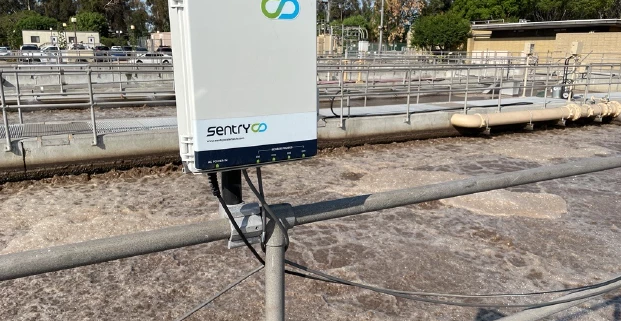
    This is exactly where GIMAT’s solution comes in. Instead of dosing based on assumptions, the team installed a SENTRY dual-sensor system. The principle is innovative: a microscopically thin biofilm of the plant’s native microorganisms grows directly on the sensors. As these microbes metabolize available carbon, they generate tiny electrical currents. The system measures, minute by minute, the actual “heartbeat” and substrate availability of the biology.

    To solve the weekend dilemma, the sensors are deployed as a strategic pair:

    Sensor 1 in the influent (after primary clarification): acts as a digital sentinel, immediately detecting when the carbon-rich brewery load disappears over the weekend or returns on Monday.

    Sensor 2 in the anaerobic zone (EBPR stage): directly measures the activity of phosphorus-accumulating organisms (PAOs). It reports in real time: “Warning—carbon limitation, phosphorus removal at risk,” or “Sufficient substrate—stop dosing.”

    Precision Control: Full Throttle and Full Stop at the Right Moment

    In practice, the result is a textbook example of modern, data-driven wastewater management. Ethanol dosing is no longer based on schedules, but on actual biological demand:

    1. Reliable compliance: when the SENTRY system detects carbon limitation, ethanol dosing starts automatically and precisely. Biological phosphorus removal continues without interruption, and effluent values remain safely below regulatory limits.
    2. Automatic cutoff: as soon as the breweries resume operation and natural carbon returns, the influent sensor responds instantly. The ethanol pump stops immediately—preventing any waste of expensive chemicals.

    Conclusion: An Investment That Pays for Itself

    This success story shows that sustainable water protection and cost-efficient plant operation are not mutually exclusive. With GIMAT’s SENTRY system, operators no longer react to past conditions but control the process proactively. Thanks to the substantial savings in ethanol consumption, the reagent-free and low-maintenance system pays for itself in a very short time—ensuring peace of mind in the control room, even over the weekend.

    https://www.gimat.de/wp-content/uploads/2026/07/sentry_746x466.webp 466 621 heartbit /wp-content/uploads/2016/12/GIMAT_Logo.png heartbit2026-07-15 11:43:152026-07-20 13:14:53When the Brewery Sleeps, the Wastewater Plant Starves: How Two Smart Sensors Solve the “Weekend Dilemma”

    Publikationen

    Archive

    • July 2026
    • March 2026
    • September 2025
    • August 2025
    • July 2025
    • June 2025
    • May 2025
    • April 2025
    • March 2025
    • February 2025
    • December 2024
    • November 2024
    • October 2024
    • October 2020
    • September 2019
    • May 2019
    • January 2019
    • October 2018
    • May 2017
    • February 2017
    • January 2016

    Service

    • Order accessories
    • Customer service request
    • Request brochure

    Contact

    GIMAT GmbH
    Liquid Monitoring

    Obermühlstrasse 70
    82398 Polling
    Germany

    Phone: +49 (0)881 628-10
    Fax: +49 (0)881 628-15
    e-Mail: info@gimat.de

    International GIMAT Agencies

    Are you interested in collaborating with GIMAT? We are looking for agents the world over with expertise in the river water, industrial water and waste water market. If you are interested, please contact us.

    Search

    Search Search

    Share this page

    •  
    © 2025 GIMAT GmbH. All rights reserved.
      • Contact
      • AGB
      • Cookie policy
      • Privacy Policy
      • Imprint
      • Webdesign PollingWebdesign Polling – Homepageerstellung, Online-Shops, Internetprogrammierung, Suchmaschinenoptimierung (SEO), Webtexterstellung, CMS, Pflege und Wartung von Webseiten – Polling, Weilheim-Schongau, München
      Scroll to top Scroll to top Scroll to top