Direct-to-chip cooling: why glycol concentration decides data centre availability
Five to ten kilowatts per rack used to be normal, today it is 50 to 150. Air cannot carry that heat away, so the coolant moves directly to the chip. That turns the composition of the fluid into an availability question, and inline refractometers from ATAGO answer it every second.
Artificial intelligence has rebuilt data centres within a few years. As compute load rises, so does power demand, and with it the heat packed into a small space. Modern server architectures reach ten to fifteen times the power density that was common a few years ago. Conventional air cooling hits its physical limit at these heat fluxes. The industry standard is therefore shifting towards direct-to-chip cooling, D2C for short.
The coolant becomes a risk factor
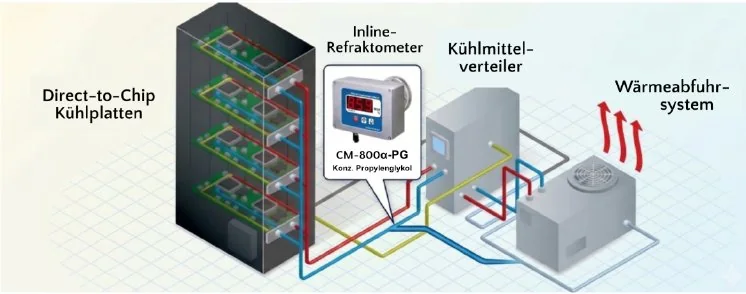
In a D2C system, a central coolant distribution unit (CDU) pushes fluid through safety piping directly to the high-performance chips. The medium is usually a mixture with around 25 % propylene glycol. That concentration is no accident but a compromise between freeze protection, corrosion protection and heat transfer. In operation it does not stay stable on its own. Evaporation, thermal stress and top-ups during maintenance change the composition, and dosing errors happen faster than expected.
Too little glycol, too much glycol
Both directions cause damage, just differently. If the propylene glycol share falls, corrosion protection weakens and the risk of microbial growth rises. Biofilms and contamination clog the fine cooling channels, cooling performance drops gradually, and in the end expensive hardware has to be replaced. If the share rises above target, the coolant becomes more viscous. Heat transfer worsens, pumps work against higher resistance, and the energy demand of the whole system climbs. A data centre can therefore lose money on a badly dosed fluid without any temperature sensor at the chips reporting a fault.
Measuring every second instead of every quarter
ATAGO inline refractometers determine the refractive index of the fluid stream continuously and convert it into propylene glycol concentration. The result travels as a standard 4–20 mA signal to the building management system (BMS/DCIM). Integrated alarm thresholds turn the reading into an early warning system: if the concentration leaves the tolerance window, make-up dosing or an alarm can be triggered before a critical state develops. The measurement needs no maintenance because the optical method works without consumables.
Two measuring points, two jobs
In the supply line, on the way to the chips, the measurement confirms that the exact target concentration arrives. In the return line the same measurement acts as a sensitive detector for change: sudden fluctuations point to micro leaks or inadmissible ingress, long before the level in the expansion tank attracts attention. Equipping both points separates cause from effect.
The right devices
Two compact models are available for installation in CDU piping. They share measuring range and accuracy and differ in their temperature window:
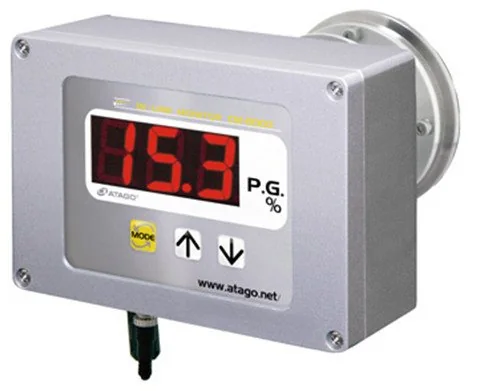
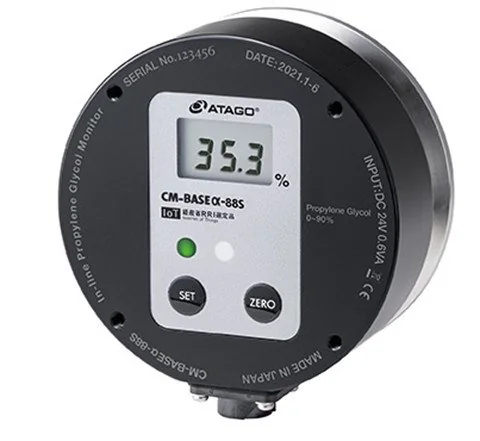
| Model | CM-800α-PG | CM-BASEα-88S |
| Measuring range | 0.0 to 90.0 % | 0.0 to 90.0 % |
| Accuracy | ±0.4 % | ±0.4 % |
| Freezing point | down to −50 °C | down to −50 °C |
| Temperature range | −15 to 160 °C | 10 to 95 °C |
The CM-800α-PG covers hot operating states thanks to its wide temperature window. The CM-BASEα-88S is the more compact option for tight spaces between servers and cooling modules. Both devices are described on the GIMAT product pages: CM-800 α PG process refractometer and CM-BASE α process refractometer.
Installation without downtime
For planners and building services engineers the intervention is small. The devices are connected to the main or bypass flow through standard, leak-tight process connections. That allows fast initial installation in the CDU and later straightforward replacement during service work without a long shutdown. New builds should plan the measuring point from the start. Retrofits are best begun in the return line, because that is where the most informative signals arrive.
Advice for data centre planners
GIMAT is an ATAGO distributor and service centre and supports selection, design and integration of the measuring point. Questions on materials, connections and signal paths are answered at info@gimat.de or by phone on +49 881 628-0.