• Deutsch Deutsch German de
    • English English English en
    +49 (0)881 628-10 | info@gimat.de
    GIMAT Liquid Monitoring
    • Products
      • Handheld Instruments
      • Online-Parameters
      • Measuring Transducers
      • Samplers
      • Online-Accessories
      • Benchtop Instruments
    • Services
    • News
    • About us
      • Case Studies
      • Publications
      • Job offers
    • Click to open the search input field Click to open the search input field Search
    • Menu Menu
    You are here: Home1 / Uncategorized
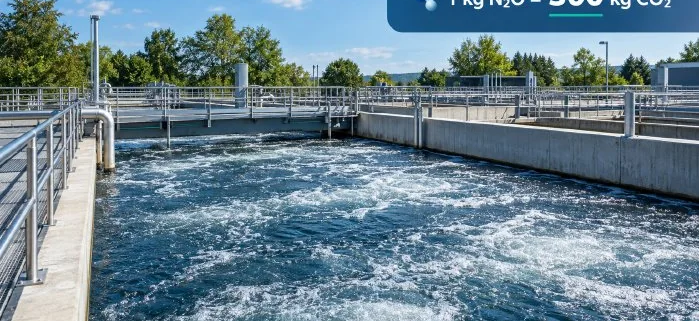
    Lachgas-Emissionen einer Kläranlage im Vergleich zum CO2-Äquivalent

    Nitrous oxide from wastewater plants: the biology in the tank decides the climate balance

    Nitrous oxide is around 300 times more potent than CO2. It forms inside wastewater plants during normal operation, and nobody sees it. The SENTRY biofilm sensor from GIMAT makes the biology in the tank visible before emissions occur.

    When a wastewater treatment plant is judged on its climate footprint, most people look at the electricity bill for aeration. The bigger problem often sits invisibly above the tank. Nitrous oxide (N2O) forms during nitrogen removal as an intermediate and escapes into the atmosphere as soon as the reaction chain in the biology breaks down. For municipalities that have to report their climate balance, this is an item that appears in no energy audit.

    Why the biology loses its rhythm

    Nitrous oxide is a normal part of nitrogen conversion. Nitrification and denitrification produce it as an intermediate stage, and under stable conditions it is processed further. It becomes critical when the process stalls. Two triggers show up in practice again and again: sudden load peaks in the influent and a shortage of easily degradable carbon, measured as BOD or readily biodegradable COD. When the denitrifying bacteria run out of energy, the chain breaks and the greenhouse gas leaves through the surface. The effluent value can still look fine at that moment. That is what makes the situation deceptive.

    Off-gas measurement shows the result, not the cause

    Many operators have invested in gas measurement in the exhaust air over the past years. Dr. Volker Koschay, managing director of GIMAT, considers that the second step before the first: such systems are expensive, maintenance-intensive and only reveal the problem once it already exists. The SENTRY probe works in the liquid phase instead. It delivers a signal every minute on how actively the microorganisms in the tank are working. With that information, aeration and carbon dosing can be adjusted before the biology tips over.

    A natural biofilm does the measuring

    The principle needs no chemicals. Microorganisms in the wastewater settle as a biofilm on the sensor surface, exactly as they would on any other material in the tank. Degrading organic matter produces a tiny electrical current. That current is proportional to the organic load and therefore a direct measure of biological activity. No reagents are required, and neither are optical lenses or fixed cleaning intervals. Maintenance stays low and operation stays stable.
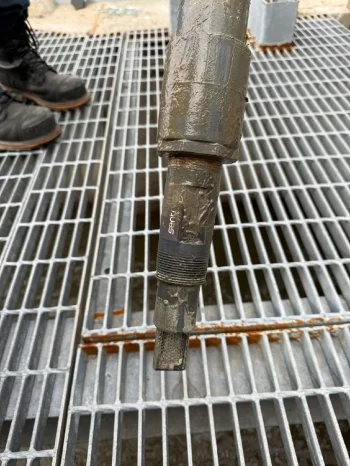
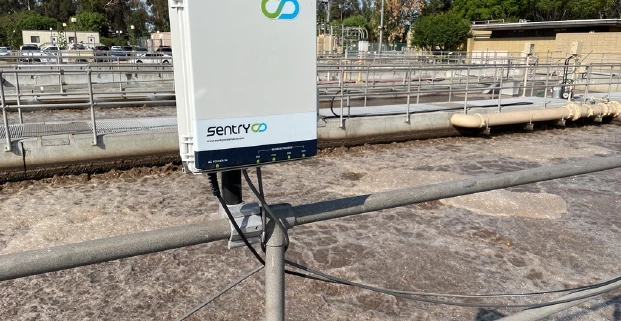
    SENTRY probe with biofilm in the aeration tank
    The SENTRY probe sits in the aeration tank. The biofilm on its surface does the measuring.

    What operators control with it

    Three things follow from the signal that matter in daily work:

    • If the denitrifiers lack carbon, the probe shows it immediately. Dosing can be corrected before nitrogen leaves as nitrous oxide instead of harmless N2.
    • During load peaks, aeration in the tanks runs feed-forward instead of reacting after the fact.
    • The system keeps running without regular cleaning cycles and without consumables.
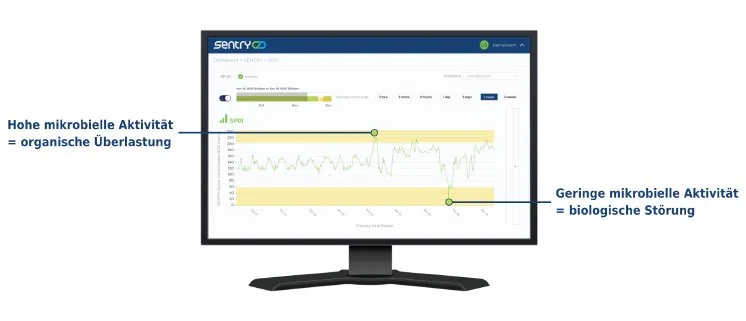
    SENTRY dashboard with real-time values
    The dashboard shows biological activity minute by minute.

    Who is behind the technology

    The system was developed by SENTRY Water Monitoring, based in Canada. The company belongs to the US group USALCO, which works in water chemistry and the digitalisation of water processes. GIMAT Liquid Monitoring in Polling distributes the sensors as exclusive representative for the German-speaking market. For operators that means one local contact who knows the application from wastewater practice.
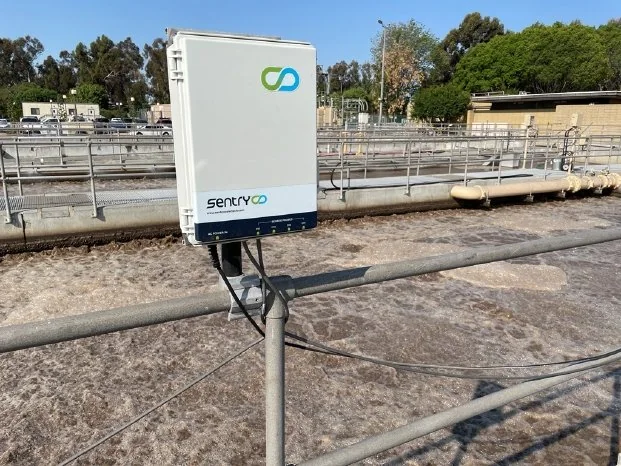
    SENTRY controller for the biofilm sensor
    The controller collects the probe signals and passes them to the plant control system.

    Bringing climate balance and effluent values together

    The EU has tightened requirements for wastewater plants for years, and at the same time municipalities and associations ask for reliable climate figures. Real-time process stabilisation serves both. It protects effluent values because the biology no longer runs at the edge. And it lowers the CO2 footprint because the nitrous oxide never forms. Operators who also run aeration on demand save electricity on top.

    Start with a pilot, then decide

    Technical data and field examples for the SENTRY BOD and toxicity sensor are available on the GIMAT product page. Anyone who wants to test the sensor at their own plant gets support with planning a pilot project by e-mail at info@gimat.de or by phone on +49 881 628-0. The best starting point is a plant that regularly struggles with load peaks. That is where the benefit shows fastest.
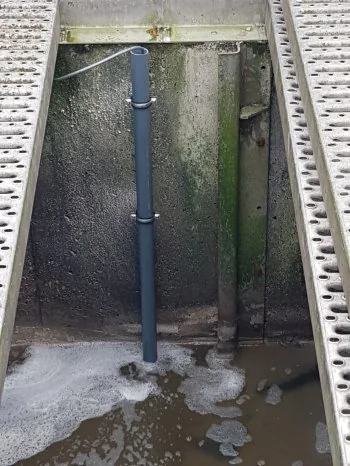
    SENTRY sensor in the influent of a wastewater plant
    The influent shows first what load the biology will face.
    https://www.gimat.de/wp-content/uploads/2026/11/sentry-lachgas-co2-aequivalent.webp 466 699 heartbit /wp-content/uploads/2016/12/GIMAT_Logo.png heartbit2026-11-19 09:00:002026-11-19 17:30:49Nitrous oxide from wastewater plants: the biology in the tank decides the climate balance
    Prozessrefraktometer ATAGO CM-800

    Brix under control: how inline refractometers cut waste and rinse water in beverage production

    Every sip should taste like the one before. At the same time, every filling line runs under cost pressure. Inline refractometers from ATAGO, integrated by GIMAT, measure Brix and concentration directly in the pipe instead of sending samples to the lab.

    Fruit juice, energy drinks, flavoured water or a syrup for food service: modern recipes no longer tolerate deviation. Sweetness shapes the taste, and taste shapes brand loyalty. Most soft drinks sit at around 10 grams of total sugar per 100 millilitres, fruit sugar and added sugar combined. That is the figure quality assurance watches, and in the lab it can only be checked by sampling. Between two samples sit hundreds of litres that have long been bottled.

    Blending: holding the recipe when the fruit varies

    The moment raw material and water meet in the mixing plant, a look into the pipe pays off. If the Brix value drifts from target, volumes can be corrected while the batch is still in the tank. With juice this is the decisive point: a refractometer captures total sugar content regardless of where it comes from. Apples from different orchards and ripeness stages bring different sweetness. That natural spread can be balanced through sugar addition until the target of, say, 10 % Brix is reached. Without that control a second error tends to slip through: if sugar drops while acid dosing continues unchanged, the taste turns sour. The customer notices, the lab often only at the next sample.

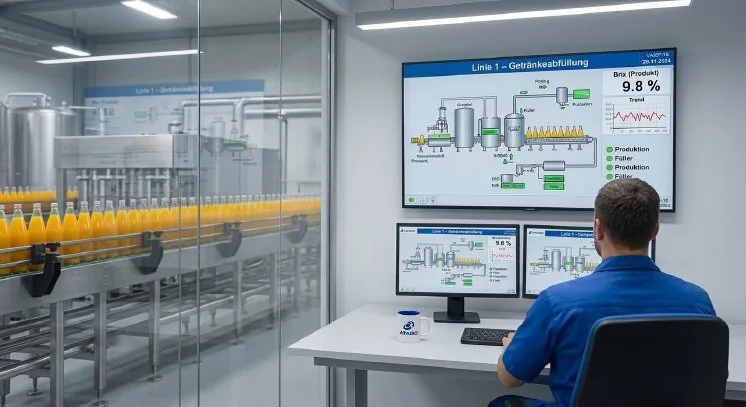
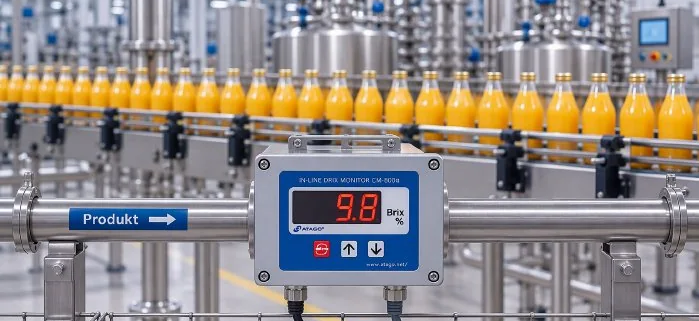
    Control room of a beverage filling line
    Brix values from the line arrive in the filling control room.

    Product changes: the border between two products

    More varieties and more flavours mean more product changes per shift on modern filling lines. Before bottling and when switching between two batches, the refractometer acts as a guard in the piping system. It detects within seconds where the new batch has replaced the old one. Mix-ups drop out, and far less product is lost at the interface. With expensive concentrates and small batches, that pays back quickly.

    CIP: when the line is really clean

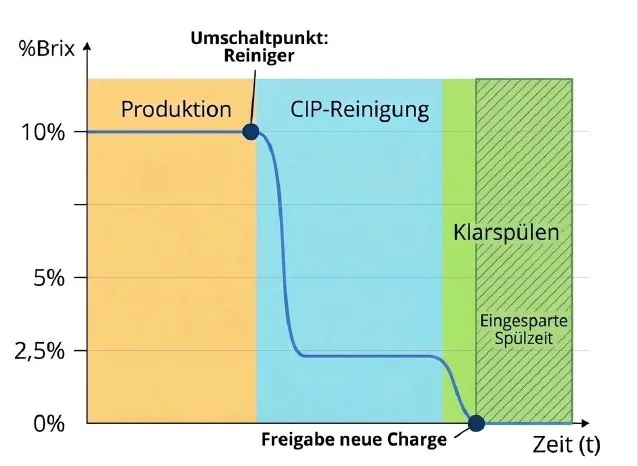
    After production comes cleaning, and that is often where the largest savings sit. During cleaning in place, the same sensor monitors the concentration of caustic soda or acid cleaner. Underdosing endangers hygiene, overdosing costs chemicals and wastewater load. The final rinse is where it gets interesting. A cleaning solution typically reads around 1.5 to 2.5 % Brix, pure drinking water reads 0.0 % Brix. Lines without sensors rinse far longer than necessary for safety reasons. Once the refractometer reports 0.0 % Brix, the line is verifiably free and the next batch can start. That saves drinking water, energy and wastewater volume, and it lowers the COD load that municipal treatment plants bill for.

    Phases of CIP cleaning
    The final rinse ends as soon as the refractometer reports 0.0 % Brix.

    Why optics measure more robustly than density here

    Density methods reach their limits with pulp, turbidity and micro air bubbles, because these distort the reading. The ATAGO process refractometers work optically on a sapphire prism and remain unaffected. Automatic temperature compensation (ATC) balances fluctuating process temperatures, up to hot filling and CIP conditions. The compact CM-Base covers straightforward tasks, while the high-resolution CM-800α comes in when space is tight.

    From the sensor to the PLC

    Sensors only deliver value once they reach the control system. GIMAT is an ATAGO distributor and service centre and works as a system integrator: selecting the right device, designing the measuring point, integrating it into the PLC, logging measurement and cleaning values. For quality managers the last point matters most. Complete batch documentation makes evidence for IFS Food or HACCP audits considerably easier, because the values come from the plant itself rather than from handwritten lists.

    What production managers should check first

    Three questions usually clarify the need: how often does the product change, how much product is lost at the interfaces, and how long does the line rinse after cleaning? Where one of these answers is uncomfortable, measuring is worth it. Details on the devices are on the product pages for the CM-800 α process refractometer and the CM-BASE α. For help choosing the right measuring point, the application engineers advise without obligation, by phone or on site: info@gimat.de.

    https://www.gimat.de/wp-content/uploads/2026/11/atago-cm-800-getraenkeindustrie-1.webp 466 699 heartbit /wp-content/uploads/2016/12/GIMAT_Logo.png heartbit2026-11-18 09:00:002026-11-19 17:30:51Brix under control: how inline refractometers cut waste and rinse water in beverage production
    Kühlkreislauf eines Rechenzentrums

    Direct-to-chip cooling: why glycol concentration decides data centre availability

    Five to ten kilowatts per rack used to be normal, today it is 50 to 150. Air cannot carry that heat away, so the coolant moves directly to the chip. That turns the composition of the fluid into an availability question, and inline refractometers from ATAGO answer it every second.

    Artificial intelligence has rebuilt data centres within a few years. As compute load rises, so does power demand, and with it the heat packed into a small space. Modern server architectures reach ten to fifteen times the power density that was common a few years ago. Conventional air cooling hits its physical limit at these heat fluxes. The industry standard is therefore shifting towards direct-to-chip cooling, D2C for short.

    The coolant becomes a risk factor

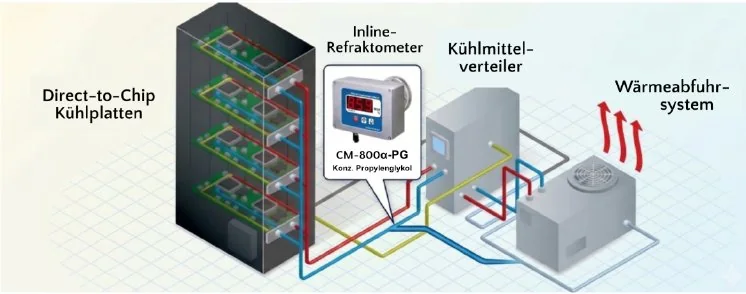
    In a D2C system, a central coolant distribution unit (CDU) pushes fluid through safety piping directly to the high-performance chips. The medium is usually a mixture with around 25 % propylene glycol. That concentration is no accident but a compromise between freeze protection, corrosion protection and heat transfer. In operation it does not stay stable on its own. Evaporation, thermal stress and top-ups during maintenance change the composition, and dosing errors happen faster than expected.

    Too little glycol, too much glycol

    Both directions cause damage, just differently. If the propylene glycol share falls, corrosion protection weakens and the risk of microbial growth rises. Biofilms and contamination clog the fine cooling channels, cooling performance drops gradually, and in the end expensive hardware has to be replaced. If the share rises above target, the coolant becomes more viscous. Heat transfer worsens, pumps work against higher resistance, and the energy demand of the whole system climbs. A data centre can therefore lose money on a badly dosed fluid without any temperature sensor at the chips reporting a fault.

    Measuring every second instead of every quarter

    ATAGO inline refractometers determine the refractive index of the fluid stream continuously and convert it into propylene glycol concentration. The result travels as a standard 4–20 mA signal to the building management system (BMS/DCIM). Integrated alarm thresholds turn the reading into an early warning system: if the concentration leaves the tolerance window, make-up dosing or an alarm can be triggered before a critical state develops. The measurement needs no maintenance because the optical method works without consumables.

    Two measuring points, two jobs

    In the supply line, on the way to the chips, the measurement confirms that the exact target concentration arrives. In the return line the same measurement acts as a sensitive detector for change: sudden fluctuations point to micro leaks or inadmissible ingress, long before the level in the expansion tank attracts attention. Equipping both points separates cause from effect.

    The right devices

    Two compact models are available for installation in CDU piping. They share measuring range and accuracy and differ in their temperature window:

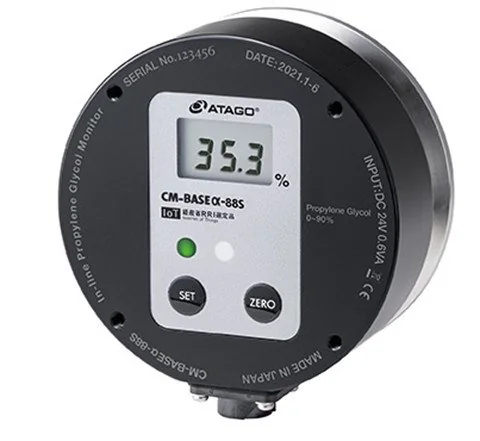
    Model CM-800α-PG CM-BASEα-88S
    Measuring range 0.0 to 90.0 % 0.0 to 90.0 %
    Accuracy ±0.4 % ±0.4 %
    Freezing point down to −50 °C down to −50 °C
    Temperature range −15 to 160 °C 10 to 95 °C

    The CM-800α-PG covers hot operating states thanks to its wide temperature window. The CM-BASEα-88S is the more compact option for tight spaces between servers and cooling modules. Both devices are described on the GIMAT product pages: CM-800 α PG process refractometer and CM-BASE α process refractometer.

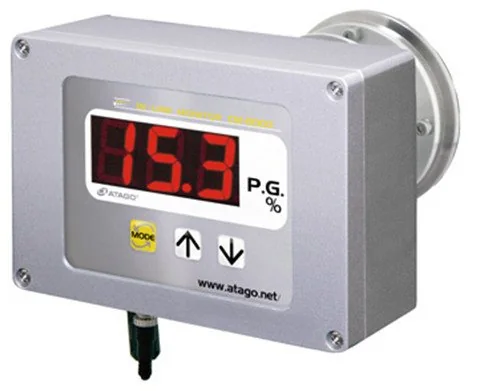
    ATAGO CM-800α-PG inline refractometer
    The CM-800α-PG covers a temperature range from −15 to 160 °C.
    ATAGO CM-BASEα-88S inline refractometer
    The CM-BASEα-88S is the compact option for tight installation spaces.

    Installation without downtime

    For planners and building services engineers the intervention is small. The devices are connected to the main or bypass flow through standard, leak-tight process connections. That allows fast initial installation in the CDU and later straightforward replacement during service work without a long shutdown. New builds should plan the measuring point from the start. Retrofits are best begun in the return line, because that is where the most informative signals arrive.

    Advice for data centre planners

    GIMAT is an ATAGO distributor and service centre and supports selection, design and integration of the measuring point. Questions on materials, connections and signal paths are answered at info@gimat.de or by phone on +49 881 628-0.

    https://www.gimat.de/wp-content/uploads/2026/11/kuehlkreislauf-rechenzentrum.webp 294 746 heartbit /wp-content/uploads/2016/12/GIMAT_Logo.png heartbit2026-08-26 09:00:002026-11-19 17:33:40Direct-to-chip cooling: why glycol concentration decides data centre availability

    AI-Based Harvest and Quality Forecasting: GIMAT Liquid Monitoring Seeks Partners from Agriculture and Food Retail

    For a joint AgTech pilot project, GIMAT Liquid Monitoring is looking for agricultural producers, grower cooperatives, and food retail companies to co-develop a digital quality and supply chain for fresh fruit.

    The perfect taste experience of fresh fruit determines success at the point of sale. To digitally bridge the gap between agricultural production and retail logistics, GIMAT GmbH Liquid Monitoring is launching a forward-looking development partnership to build an AI-based harvest and quality forecasting system.

    For this hands-on pilot phase, the company is seeking close collaboration with innovative partners from the food retail sector as well as progressive farms and producer cooperatives. While growers act as active data providers directly in the field, retail partners validate logistics and goods-inbound processes in real-world operations. Both sides benefit from an exclusive technological and knowledge advantage within a data-driven supply chain.

    The Challenge in Food Retail: Waste Due to Reactive Quality Control

    Currently, quality control in food retail is largely reactive, typically performed at goods receipt in central distribution centers. Late insights into the actual ripeness level lead to logistical inefficiencies, unpredictable quality deviations, and avoidable spoilage (food waste). GIMAT breaks with this paradigm through a predictive, data-driven “farm-to-fork” approach.

    The Blind Spot: Continuous Ripening Along the Supply Chain

    The sensitive balance between sweetness (Brix value) and acidity continuously changes during transport from the field to the supermarket shelf due to natural ripening processes. A single-point inspection is therefore insufficient. The pilot project establishes measurable control points along the entire chain—from determining optimal harvest maturity, to goods receipt at the distribution center, and finally to consumption ripeness at the retail shelf. Development partners contribute their operational data to train the AI with real-world logistics and ripening scenarios.

    The Foundation: Non-Destructive, Real-Time Quality Measurement at Every Stage

    Using mobile, non-destructive infrared and digital measurement technology from ATAGO—such as the innovative ATAGO HIKARi infrared refractometers or the digital PAL-BX|ACID series—growers can capture key quality parameters directly on the plant, completely contactless. The system measures the critical interaction between Brix value and acidity holistically. Since measurements with these handheld refractometers are completed within seconds, the same method can be applied easily and rapidly at all downstream stages of the supply chain. All devices are fully digital and equipped with integrated NFC (Near Field Communication): measurement data can be transferred directly from the ATAGO device to a smartphone app and then uploaded to the cloud—fully digitized and without manual effort.

    The Vision: A Shared Cloud for Maximum Planning Reliability

    On the software side, GIMAT leverages a proven network and a long-standing technology partner that has already delivered successful large-scale projects in other industries. Field data is seamlessly uploaded to a smart cloud platform. This is where the key value for supply chain transparency is created: both growers and retail partners have equal access to the same real-time ripening curves. This end-to-end digital transparency significantly improves planning reliability for both sides:

    • For agricultural producers & cooperatives: Continuous proof of product quality, reduced claims through objective data, and positioning as digitally advanced premium suppliers with reliable delivery commitments.
    • For food retailers: Buyers and logistics teams can precisely manage shipments just-in-time before spoilage occurs. This drastically reduces write-offs, improves shelf freshness, and ensures consistent fruit quality for consumers.

    A Strong Technology Alliance as the Foundation

    This innovation project successfully connects field data to the cloud through a combination of expertise: GIMAT GmbH is the only authorized and certified ATAGO service center in Germany as well as across Central and Northern Europe. The company is not merely a distributor—it possesses deep process and technical expertise in the high-precision optical and digital measurement systems of ATAGO (Japan), a global market leader. This engineering know-how forms the foundation for developing advanced data interfaces.

    Together with the proven software and cloud architecture expertise of its long-standing development partner, data streams are consolidated into an AI-based prediction model that combines field measurements with climate data.

    Call for Development Partners: Shape the Future of AgTech Supply Chains

    To develop this connected, AI-driven supply chain in a practical and demand-oriented way from the ground up, GIMAT is now seeking true development partnerships with forward-thinking retail companies and ambitious producers. Selected partners will contribute their real-world application expertise, actively shaping the digital supply chain of the future while securing exclusive market advantages.

    Contact for Project and Partnership Inquiries

    Interested retail companies (innovation teams/purchasing departments) and producer cooperatives are invited to contact Managing Director Dr.-Ing. Volker Koschay directly at: volker.koschay@gimat.de


    https://www.gimat.de/wp-content/uploads/2026/07/ATAGO_HIKARI_746x466.webp 466 613 heartbit /wp-content/uploads/2016/12/GIMAT_Logo.png heartbit2026-07-16 11:53:152026-11-19 17:38:27AI-Based Harvest and Quality Forecasting: GIMAT Liquid Monitoring Seeks Partners from Agriculture and Food Retail

    When the Brewery Sleeps, the Wastewater Plant Starves: How Two Smart Sensors Solve the “Weekend Dilemma”

    Wastewater treatment plant operators can reduce operating costs and reliably meet discharge limits thanks to SENTRY bio-sensors.

    A strict effluent limit, two large breweries “off duty,” and a biological system on hunger strike: when local industries shut down production over the weekend, many wastewater treatment plants are pushed into a critical imbalance. Using a current customer case, GIMAT Liquid Monitoring demonstrates how a biological two-sensor system reduces the consumption of costly auxiliary chemicals like ethanol, protects budgets, and safeguards receiving waters.

    The Invisible Drama on Friday Evening

    Wastewater treatment plants never sleep. But their most important engine—the billions of microorganisms in the activated sludge tank—operates in sync with local industry. During the week, everything runs smoothly at the affected plant: two large breweries discharge their production wastewater. For the bacteria, this is a feast. They consume the dissolved carbon and use that energy to biologically remove environmentally harmful phosphorus from the water (enhanced biological phosphorus removal, EBPR).

    But right on schedule—weekends and public holidays—the shock follows: brewery production stops, and the corresponding wastewater inflow suddenly ceases. At the treatment plant, a biological famine sets in. Without their usual carbon source, the microbiology slows down or stops. Natural phosphorus removal collapses.

    The consequences are severe: total phosphorus (P\_tot) levels at the plant effluent rise uncontrollably. Even rapidly intensified chemical precipitation using iron salts has often failed in the past to consistently meet strict regulatory discharge limits. The plant regularly found itself in a critical compliance situation.

    Ethanol: The Expensive Lifeline

    The process engineering solution for starving bacteria seems simple: supply an external carbon source—high-purity ethanol. It acts like a liquid energy booster and immediately brings the biological process back on track.

    But ethanol has a downside: it is extremely expensive.

    Until now, manual dosing has been a risky guessing game:

    • Dose too late, and phosphorus levels spike into the critical range—risking permit violations and regulatory intervention.
    • Dose too long (for example, if the breweries resume discharge earlier than expected), and the plant wastes thousands of euros on unnecessary chemical consumption.

    Even fixed timer-based dosing fails completely in this situation. The plant urgently needed “eyes” to monitor the bacteria’s metabolic state in real time.

    Der digitale Blick auf das Wohlbefinden der Bakterien

    This is exactly where GIMAT’s solution comes in. Instead of dosing based on assumptions, the team installed a SENTRY dual-sensor system. The principle is innovative: a microscopically thin biofilm of the plant’s native microorganisms grows directly on the sensors. As these microbes metabolize available carbon, they generate tiny electrical currents. The system measures, minute by minute, the actual “heartbeat” and substrate availability of the biology.

    To solve the weekend dilemma, the sensors are deployed as a strategic pair:

    Sensor 1 in the influent (after primary clarification): acts as a digital sentinel, immediately detecting when the carbon-rich brewery load disappears over the weekend or returns on Monday.

    Sensor 2 in the anaerobic zone (EBPR stage): directly measures the activity of phosphorus-accumulating organisms (PAOs). It reports in real time: “Warning—carbon limitation, phosphorus removal at risk,” or “Sufficient substrate—stop dosing.”

    Precision Control: Full Throttle and Full Stop at the Right Moment

    In practice, the result is a textbook example of modern, data-driven wastewater management. Ethanol dosing is no longer based on schedules, but on actual biological demand:

    1. Reliable compliance: when the SENTRY system detects carbon limitation, ethanol dosing starts automatically and precisely. Biological phosphorus removal continues without interruption, and effluent values remain safely below regulatory limits.
    2. Automatic cutoff: as soon as the breweries resume operation and natural carbon returns, the influent sensor responds instantly. The ethanol pump stops immediately—preventing any waste of expensive chemicals.

    Conclusion: An Investment That Pays for Itself

    This success story shows that sustainable water protection and cost-efficient plant operation are not mutually exclusive. With GIMAT’s SENTRY system, operators no longer react to past conditions but control the process proactively. Thanks to the substantial savings in ethanol consumption, the reagent-free and low-maintenance system pays for itself in a very short time—ensuring peace of mind in the control room, even over the weekend.

    https://www.gimat.de/wp-content/uploads/2026/07/sentry_746x466.webp 466 621 heartbit /wp-content/uploads/2016/12/GIMAT_Logo.png heartbit2026-07-15 11:43:152026-07-20 13:14:53When the Brewery Sleeps, the Wastewater Plant Starves: How Two Smart Sensors Solve the “Weekend Dilemma”

    Did you know that the Water Resources Act affects your cooling lubricant system?

    Many companies use cooling lubricant emulsions (KSS) – but not all of them know that these substances must be classified according to water hazard classes (WGK) and that handling them is subject to strict requirements under German water legislation.

    The general requirements of the Water Resources Act (WHG) are specified in the AwSV (Ordinance on Installations for Handling Substances Hazardous to Water).
    Even individual tanks with a volume of less than 220 l can be AwSV-relevant – but the actual topic only really becomes relevant with automation.

    Automation is not a risk – if it is done right:

    Manual filling processes are usually observed directly – employees recognize overfilling immediately.

    Automated systems, on the other hand, run unattended – and this is precisely why the AwSV requires technical safeguards such as overfill protection, leakage detection and retention devices for such systems.

    This is no reason to worry – but a reason to rely on well thought-out systems.

    The good news:

    There are solutions that not only fulfill these requirements, but also implement them in a practical and reliable manner – first and foremost Brisco Systems GmbH:
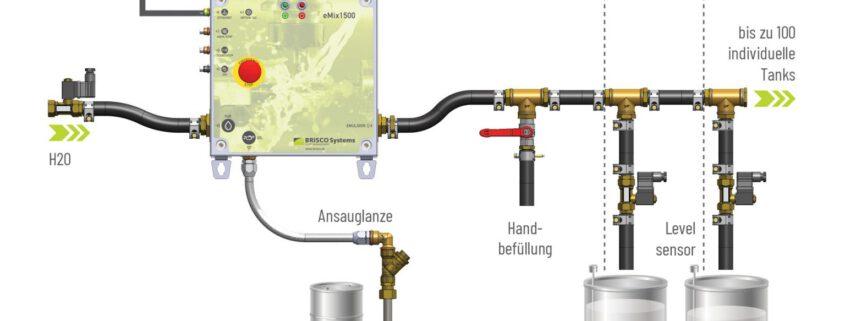
    With the eMix1500 in combination with the eLevel100, a system is available that:

    • via a fixed cable connection,
    • an integrated level sensor,
    • and an automatic emergency stop system

    and thus technically rules out overfilling.

    Are you planning to fill your cooling lubricant tanks automatically?

    We have been dealing with the requirements of the Water Resources Act and the AwSV for many years. As a system integrator and official sales partner of Brisco Systems in Germany, GIMAT Liquid Monitoring advises companies on the planning and design of AwSV-compliant systems.

    Feel free to contact us – you are in the best hands with us.

    https://www.gimat.de/wp-content/uploads/Blog/KSS-Gimat-Brisco-emix.jpg 1013 1536 heartbit /wp-content/uploads/2016/12/GIMAT_Logo.png heartbit2025-09-28 09:57:342025-09-28 09:57:34Did you know that the Water Resources Act affects your cooling lubricant system?

    With cooling lubricants, droplet size determines the emulsion quality

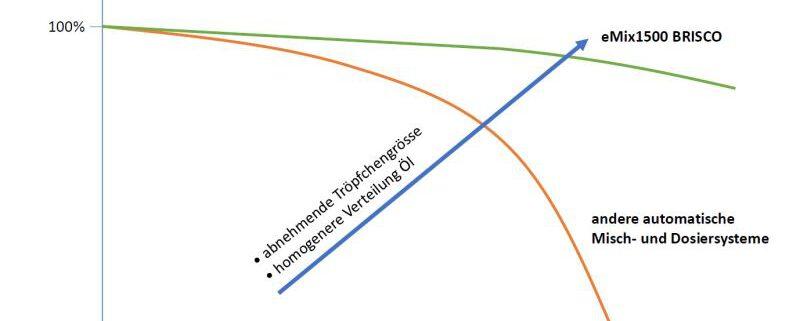
    Small droplets and homogeneous oil distribution are crucial for the service life of your cooling lubricant emulsions – and therefore your operating costs. We have intensively studied the available systems for the automatic mixing and dosing of cooling lubricant emulsions. We compared various providers and technologies – with a clear result:

    The eMix1500 from the Swiss company Brisco Systems GmbH convinced us the most in terms of mixing quality, droplet size distribution, ease of use and integration capability. That is why we have included the eMix1500 in our sales program and are now offering it as a central component of our (hybrid) automation solutions in cooling lubricant fluid management.

    The eMix1500 works with SmartFusion technology. This ensures a precise mixing ratio, pressure and turbulence. This creates micro-droplets that are optimally distributed in the medium and enable a significantly longer service life. The result: lower concentrate consumption and more stable processes.

    Micro-droplets. Mega effect: eMix1500 revolutionizes your coolant fluid management. Interested? Please contact us.

    https://www.gimat.de/wp-content/uploads/Blog/troepfchengroesse.jpg 443 800 heartbit /wp-content/uploads/2016/12/GIMAT_Logo.png heartbit2025-09-19 10:46:102025-09-19 10:46:10With cooling lubricants, droplet size determines the emulsion quality

    Innovation and Team Spirit: Our Journey Through the World of Wastewater Technology with SENTRY

    As representatives of the Canadian company SENTRY – the leading manufacturer of biosensors – we offer state-of-the-art solutions for monitoring wastewater quality. The innovative and patented measurement process enables the precise real-time detection of the organic load in the influent of wastewater treatment plants. By deploying a SENTRY measurement system at the effluent of the biological treatment stage, you gain further valuable insights into the success of your degradation processes.

    Currently, Vibhu Srinivasa, Key Account Manager at SENTRY, and I are on tour, visiting several wastewater treatment plants in Germany where we are conducting live tests of the SENTRY measurement systems.

    With brilliant sunshine and great team spirit, the work becomes twice as enjoyable – heartfelt thanks, Vibhu, for your valuable insights which enrich our joint efforts.

    Do you also have an interest in seeing our system in action or learning more about our innovative approaches in wastewater measurement technology? We look forward to hearing from you!

    https://www.gimat.de/wp-content/uploads/Blog/1747773468020_1.jpg 600 450 heartbit /wp-content/uploads/2016/12/GIMAT_Logo.png heartbit2025-05-26 13:57:372026-01-04 20:15:08Innovation and Team Spirit: Our Journey Through the World of Wastewater Technology with SENTRY

    GIMAT devices have been a permanent fixture at the Legden wastewater treatment plant in the Münsterland region for nearly four decades.

    With durable, maintenance-friendly, and easy-to-operate devices, we support the plant personnel in carrying out their work efficiently. We are pleased that the Legden treatment plant continues to rely on our quality and has once again trusted GIMAT for the partial renewal of their influent measurement systems. For the continuous measurement of pH, conductivity, and temperature, a new GICON 1000 multi-parameter transmitter was recently acquired.

    The existing probes and cables are compatible with the new device and could therefore continue to be used. This made the replacement and upgrade of the measuring device cost-effective and straightforward. Furthermore, the measurement setup was enhanced with an ultrasonic sensor for flow measurement, which was easily possible thanks to the additional input of the new GICON 1000 transmitter and its device software. Despite this expansion, the new device could be installed in the exact same location as the old one, where the cable connections were already present, within a very short time.

    As the example of the Legden treatment plant has demonstrated for many, many years, our devices last a very long time and rarely require repairs. The longevity and high quality of our products therefore provide financial benefits for operators. Operation and maintenance are also extremely simple.

    A heartfelt thank you to the municipality of Legden and the plant staff, especially André Salewski and Thomas Bröker, for the long-standing partnership and trust in our products. Our customers’ satisfaction is our greatest success and drives us every day.

    Interested in durable and user-friendly measurement technology? Contact us and discover how GIMAT can optimize your plant too!

    https://www.gimat.de/wp-content/uploads/Blog/Klaeranlage_Legden_im_Muensterland.jpg 707 800 heartbit /wp-content/uploads/2016/12/GIMAT_Logo.png heartbit2025-04-08 15:55:022025-04-08 15:55:02GIMAT devices have been a permanent fixture at the Legden wastewater treatment plant in the Münsterland region for nearly four decades.

    VIBA_EX – The new device reliably removes (Corona-)viruses and bacteria

    Covid­19 / Corona ­ More safety forcustomers, patients and employeeswith cents for disinfecting air.

    The corona pandemic hit numerous countries in the first half of 2020 with high numbers of infections,numerous victims and devastating economic consequences.

    The highly contagious virus spreadsthrough the air and, under suitable conditions, can persist as an aerosol for a long time.

    Badly ventilated interior rooms are the main sources of transmission with particularly high infection rates. UV-C light kills viruses and bacteria.

    An UV-based air disinfection device eliminates infectious germs inthe room air and increases safety for employees and customers.

    VIBA_EX, the modern air purifier from GIMAT, for room sizes up to 100 m² is now fully developed and affordable.

    The Covid-1 9 disease, which began to spread in late 2019, has developed into a global pandemic within a few months.


    Progress and symptoms of Covid­ 19


    VIBA_EX AnwendungsbeispielVIBA_EX Anwendungsbeispiel
    VIBA_EX Anwendungsbeispiel
    VIBA_EX Anwendungsbeispiel

    A disease with Covid-19 lasts on average two to six weeks. Typical consequences of a Covid-19 disease are difficult to describe. In fact, a rangeof possible symptoms was observed in the recorded cases ofillness, which can occur to different degrees. Patients sick with Covid-19 often suffered froma cough, feveror common cold.

    Disorders of thesense of smell and taste were also recordedand, inrarercases, numerous other symptoms, including shortness of breath andvarious types of pain. Th ebest known is probably the risk of severe pneumonia caused byCovid-19, which can also lead to death.

    However, the disease can also proceed without any symptoms. Anyone who has survived Covid-19, in the best case after a mild course of the disease, might might still be struck. A medical study shows that consequences for the heart arelikely: 60% of a group of patients who had recently over come Covid-19 disease, myocarditis was found, even though two thirds of thosetested only had a light course of disease, which they could cure at home.


    Download Application News

    VIBA_EX Application News Air Disinfection

    https://www.gimat.de/wp-content/uploads/Unorganized/viba_ex_news.jpg 500 500 heartbit /wp-content/uploads/2016/12/GIMAT_Logo.png heartbit2020-10-19 14:27:122020-10-19 17:57:21VIBA_EX – The new device reliably removes (Corona-)viruses and bacteria
    Page 1 of 212

    Publikationen

    Archive

    • November 2026
    • August 2026
    • July 2026
    • March 2026
    • September 2025
    • August 2025
    • July 2025
    • June 2025
    • May 2025
    • April 2025
    • March 2025
    • February 2025
    • December 2024
    • November 2024
    • October 2024
    • October 2020
    • September 2019
    • May 2019
    • January 2019
    • October 2018
    • May 2017
    • February 2017
    • January 2016

    Service

    • Order accessories
    • Customer service request
    • Request brochure

    Contact

    GIMAT GmbH
    Liquid Monitoring

    Obermühlstrasse 70
    82398 Polling
    Germany

    Phone: +49 (0)881 628-10
    Fax: +49 (0)881 628-15
    e-Mail: info@gimat.de

    International GIMAT Agencies

    Are you interested in collaborating with GIMAT? We are looking for agents the world over with expertise in the river water, industrial water and waste water market. If you are interested, please contact us.

    Search

    Search Search

    Share this page

    •  
    © 2025 GIMAT GmbH. All rights reserved.
      • Contact
      • AGB
      • Cookie policy
      • Privacy Policy
      • Imprint
      • Webdesign PollingWebdesign Polling – Homepageerstellung, Online-Shops, Internetprogrammierung, Suchmaschinenoptimierung (SEO), Webtexterstellung, CMS, Pflege und Wartung von Webseiten – Polling, Weilheim-Schongau, München
      Scroll to top Scroll to top Scroll to top