Full Automation at Any Cost? Why “Hybrid” Is Often the More Economical Choice
In coolant management, there are three paths to automation: partial, full, or hybrid automation. All have their justification, but in the end, economic efficiency is what matters.
For small and medium-sized enterprises in particular, we at GIMAT have defined a smart middle ground with the DOSIMETRIX (registered as a utility model with the German Patent and Trademark Office, DPMA): hybrid automation.
What does it entail?
- Automatic core: Mixing and dosing are 100% automatic (eMix1500). This guarantees maximum precision and stabilizes the process on a long-term basis.
- Real-time transparency: The fill level is continuously monitored “live” and without contact. The system operates completely maintenance-free in this regard.
- Human-in-the-loop: The human operator remains the crucial corrective element. Why? Because any inline sensor technology—no matter how precise—requires regular attention when dealing with demanding media (such as esters or glycol) or the “natural” pH drift. We do not promise a “one-size-fits-all, all-inclusive carefree package” that ignores physical necessities. Targeted digital manual measurement is often more reliable here than highly complex sensor technology that still requires manual cleaning and calibration.
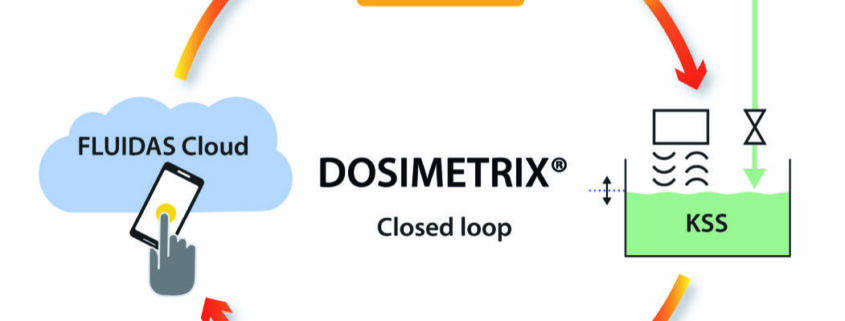
- Closed-loop digitalization: All data flows into the FLUIDAS cloud. The system automatically reports requirements, controls the replenishment process itself, and documents everything in a legally compliant manner. This creates a closed control and information loop (see graphic).One detail that makes our ‘closed loop’ particularly efficient: If you use ATAGO refractometers, you can transfer the measured values directly to the app and the FLUIDAS cloud using the integrated NFC function. No manual logging, no transmission errors. For all other measured variables, the system remains flexible and allows manual entry—ensuring the data foundation for the eMix1500 is always complete.
Conclusion:
If an expert has to be on-site anyway for the maintenance of the measuring systems, our hybrid approach is often the smarter path: It massively relieves personnel of mixing and dosing tasks, while leveraging human expertise for the final checks.
This saves high investment costs and creates genuine transparency—without raising false expectations of maintenance-free full automation.
How do you handle this in practice? Do you consistently rely on “full auto,” or is the human factor still the most important supervisory authority in your operations?