I often visit customers and find that in many industrial facilities, the automatic recording of measurement data at certain monitoring points is still a challenge. This is particularly true for older existing buildings with inadequate cable infrastructure. The result: Data is often recorded locally using paper chart recorders or data loggers – a cumbersome, time-consuming, and decentralized process.
LoRaWAN can solve such problems. This radio technology enables the wireless transmission of measurement values, such as pH, temperature, or conductivity, from remote or difficult-to-access areas within a facility. LoRaWAN operates with very high energy efficiency. The installed transmitters run on an integrated battery, which allows for several years of operation. The data is stored centrally and is accessible at any time – whether from the control room or on the go.
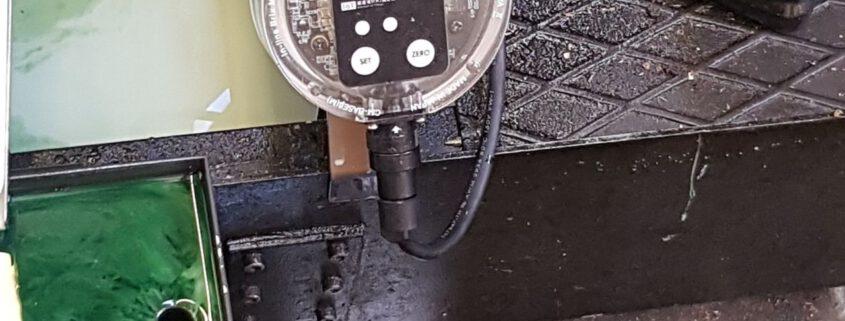
An example: In an outdoor area of an industrial plant: Small transmitters (so-called nodes) can be easily retrofitted to the 4-20 mA signal output, which is often available for online measurements. From there, data is automatically transmitted, even from wastewater manholes, to a gateway placed in a central operations building. Via LAN or LTE, the data then reaches a cloud, where it can be stored securely and without gaps and analyzed – ideal for process optimization, as well as for documentation and proving ongoing compliance with legal requirements.
Overview of the advantages:
- Centralization: All wastewater data is centralized, providing better overview, faster decision-making, and constant access to data.
- Time and Cost Savings: No manual data collection is required, eliminating “analog” documentation.
- Flexibility: Older systems can also be easily retrofitted. Nearly unlimited scalability.
- Reliability: Large transmission range, even possible through thick walls.
Thus, LoRaWAN enables simple, reliable, and wireless data transmission – the perfect solution for digitizing your wastewater measurement technology. Our team at GIMAT is happy to assist with the selection and supply of hardware, as well as the setup of the complete system.